Few places on the North Wales coast offer the drama and accessibility of Penmon Point, Anglesey. Sitting on the easternmost tip of the island where the Menai Strait meets the Irish Sea, this rugged headland is home to the iconic black-and-white Trwyn Du Lighthouse and looks directly out toward Puffin Island (Ynys Seiriol).
For landscape photographers, Penmon Point is a location of two distinct moods. Arrive before dawn and you can witness fiery sunrise colour bursting behind the tower; stay as the tide shifts and you can use long exposures to turn the fast-moving currents into glass.
Here is the story behind my latest images from Penmon Point, along with practical tips if you are planning your own visit. (For even more locations, tide charts, and exact GPS pins across the region, take a look at my Photographing North Wales Book.)
Chasing Sunrise Colour at Penmon Point
Because Penmon Point faces east-northeast, it is one of the finest sunrise locations on Anglesey. On a clear or broken-cloud morning, the sun rises directly behind Puffin Island and illuminates the sky behind Trwyn Du Lighthouse.
The window for the best colour is brief. Arriving at least 45 minutes before official sunrise gives you time to scout the rocky shoreline during blue hour, when the lighthouse lamp is still flashing against the deep indigo sky. As the horizon warms into amber and rose, the black-and-white bands of the 1838 tower create a striking silhouette against the glow.
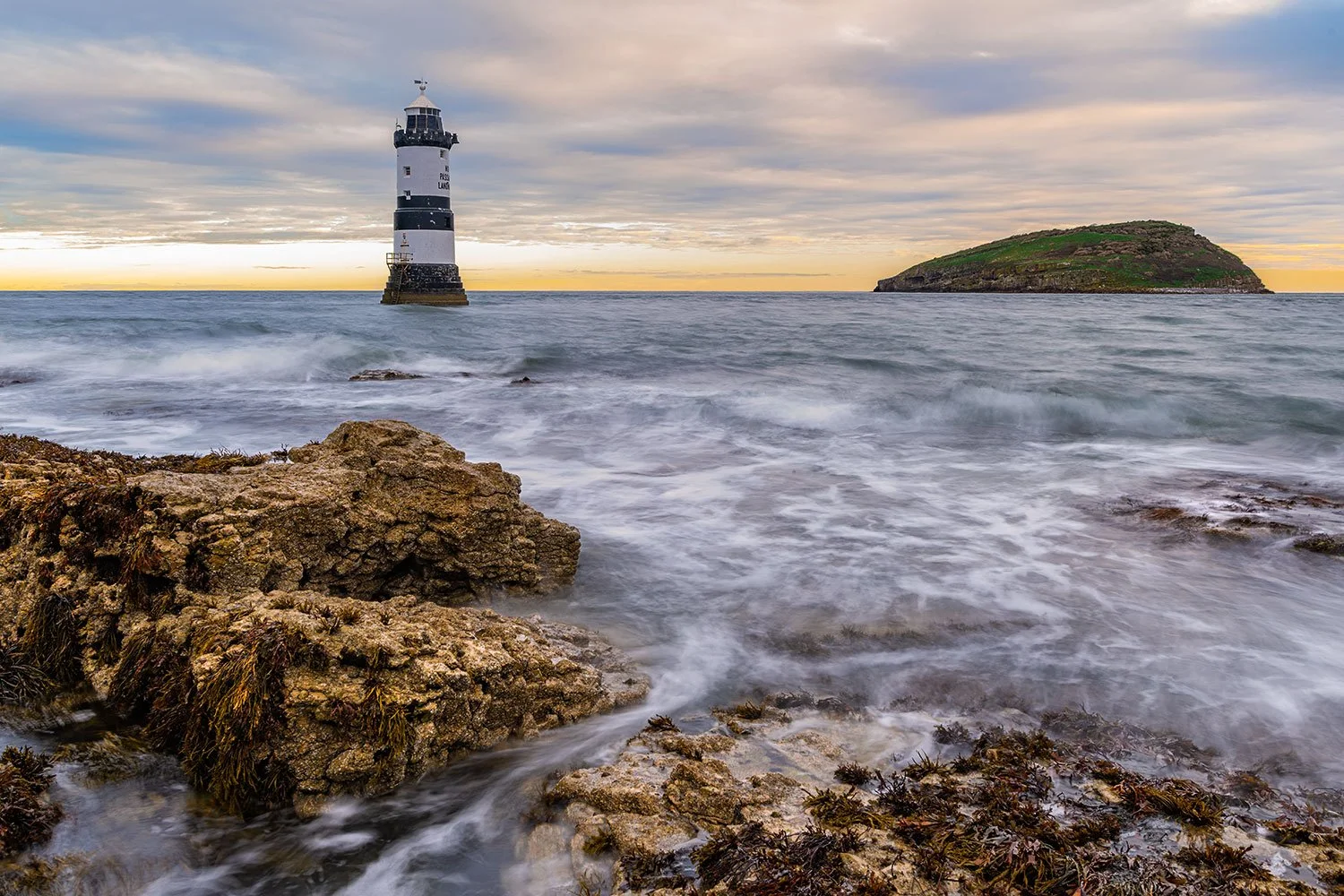
First light breaking behind Trwyn Du Lighthouse at Penmon Point, Anglesey
Long Exposure Seascape Photography at Trwyn Du Lighthouse
Once the early morning colour fades, Penmon Point transforms into an ideal subject for long exposure photography. The narrow channel between the mainland and Puffin Island creates fierce tidal races, meaning the water is rarely still—even on a calm day.
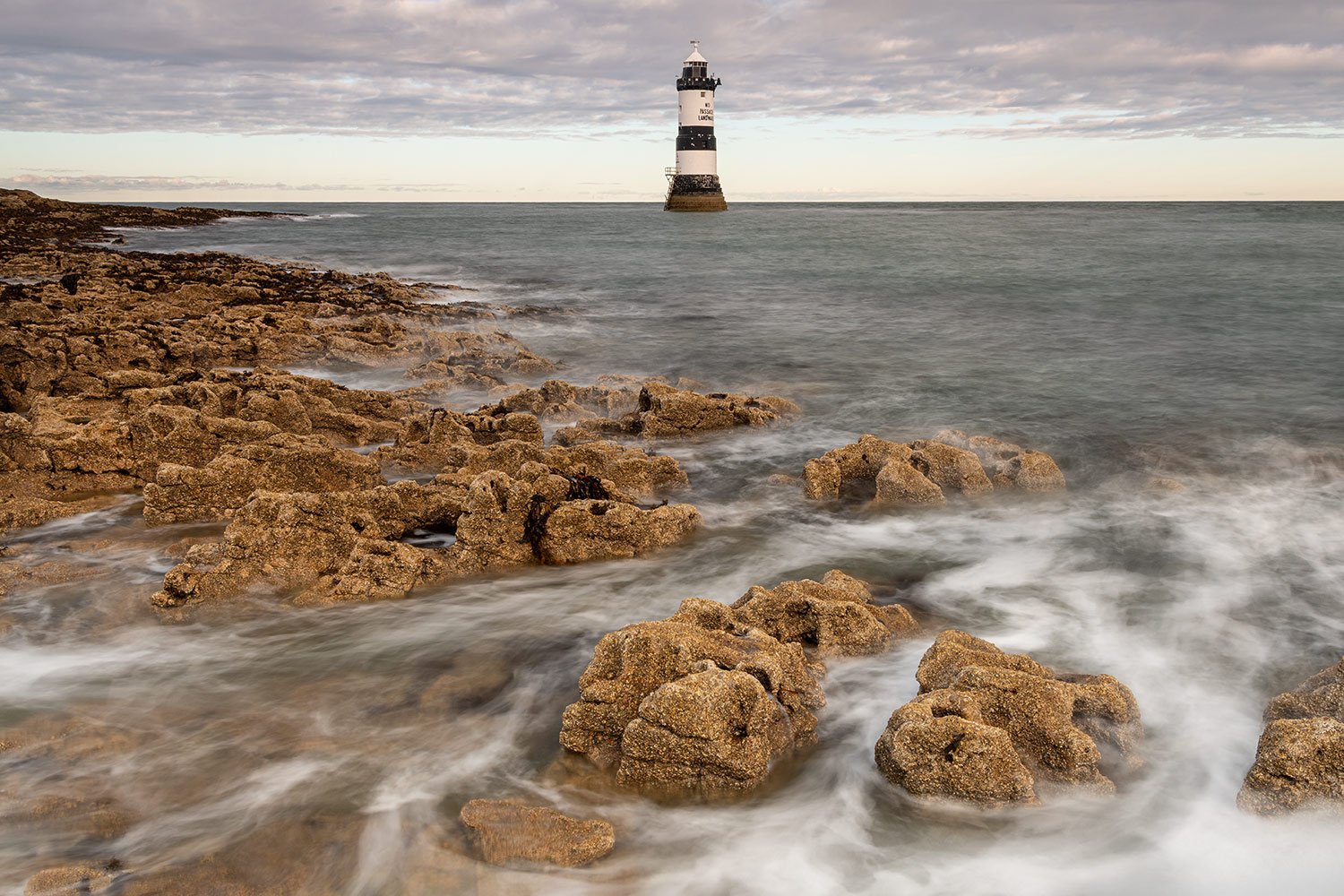
A receding high tide is the perfect time for some long exposure shots of Trwyn Du lighthouse
Using a 6-stop or 10-stop Neutral Density (ND) filter allows you to stretch shutter speeds from 30 seconds up to several minutes. Doing so strips away the chaotic chop of the Menai Strait, leaving a minimalist, painterly surface that draws the eye straight toward the geometric lines of the lighthouse.
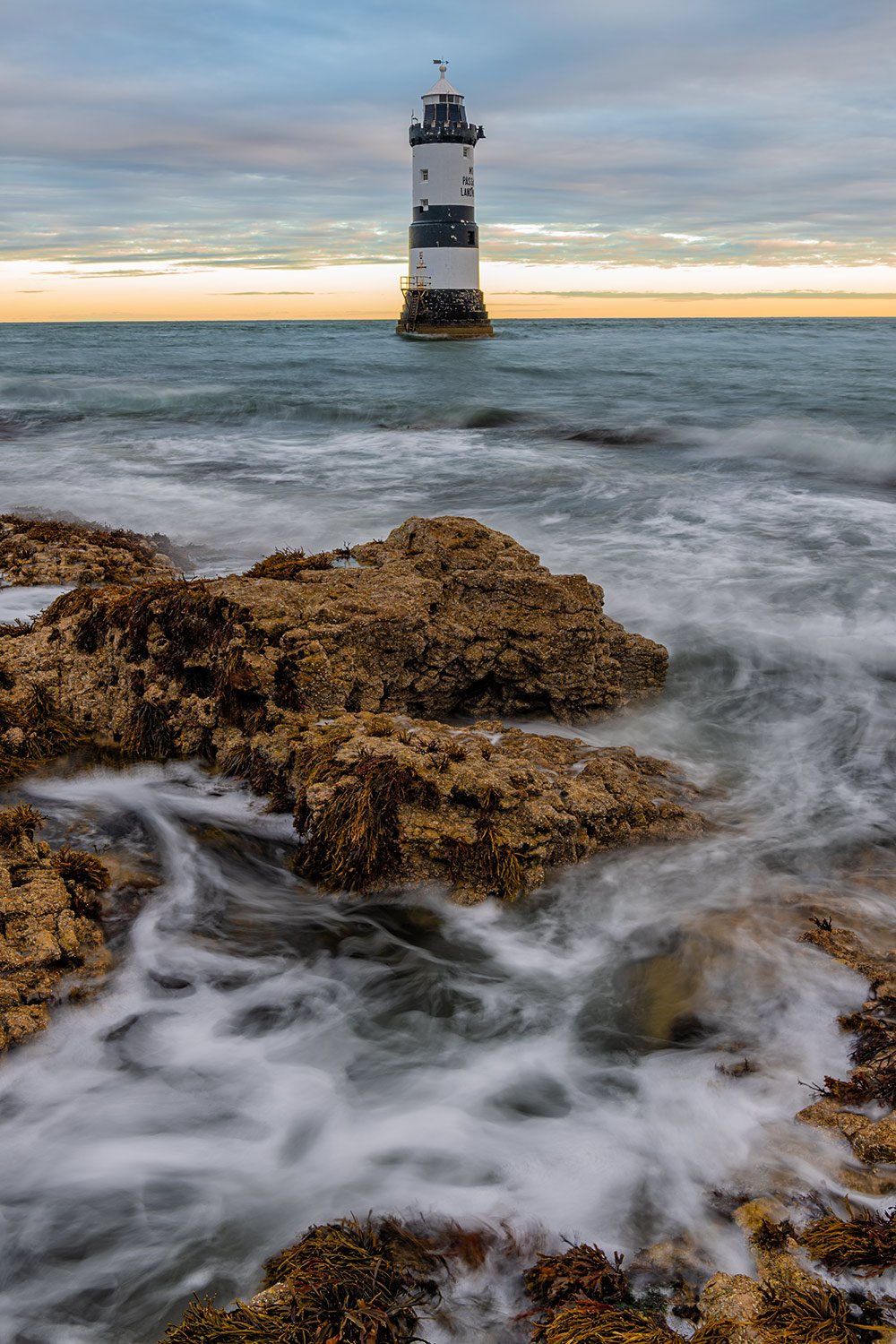
Composition Tips for Penmon Lighthouse
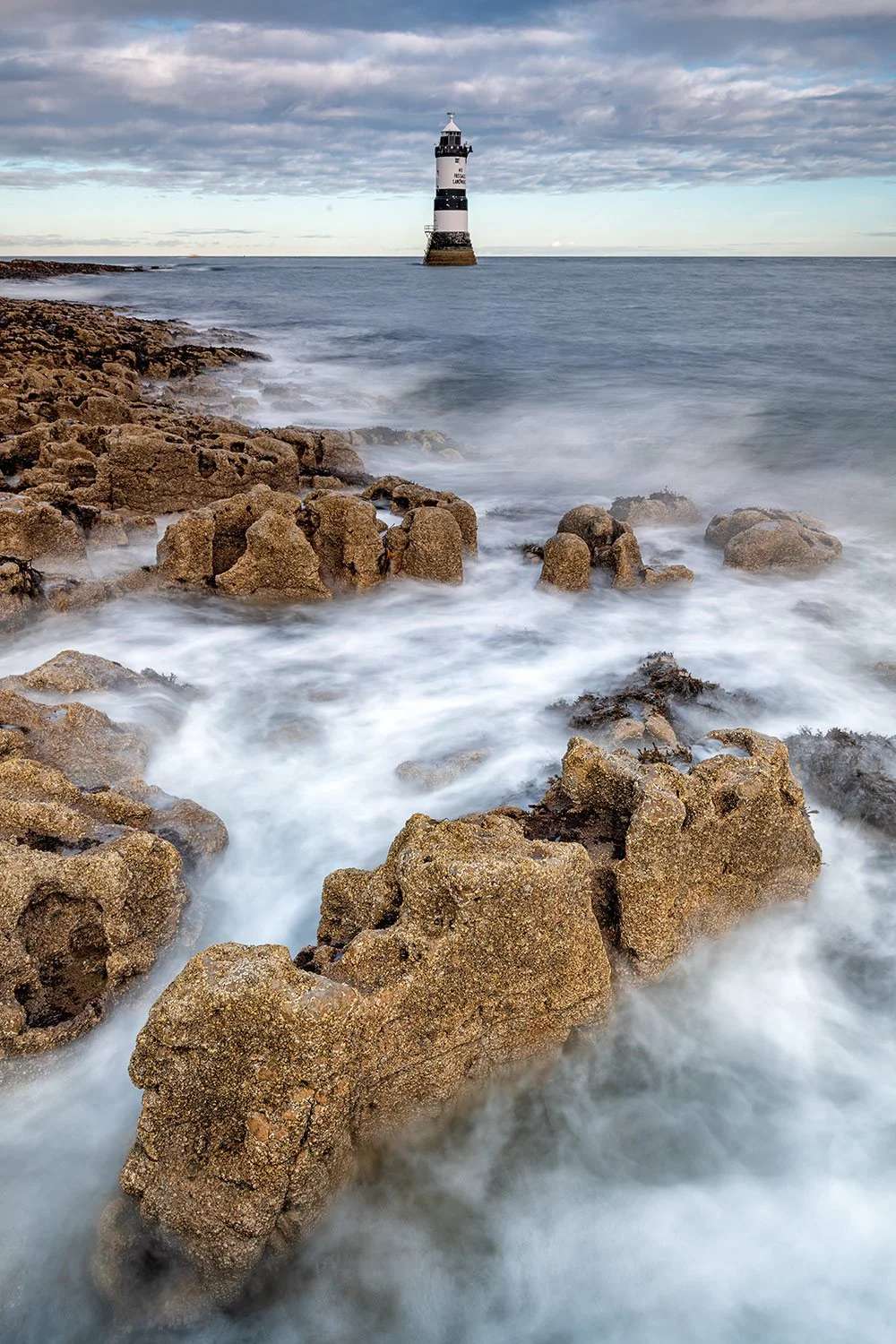
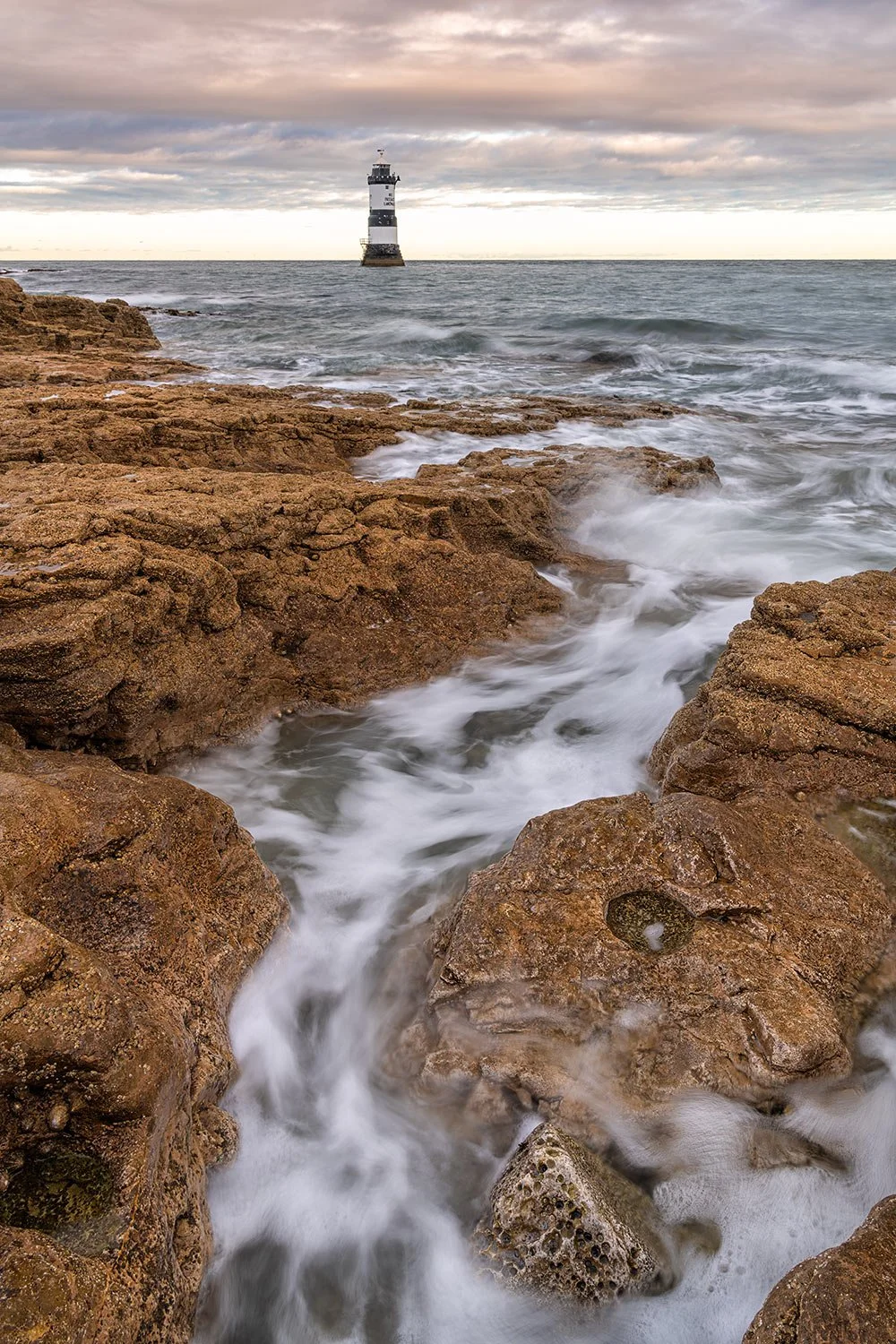
Use the shoreline rocks as leading lines: At mid-to-low tide, wet limestone boulders and seaweed-covered ledges emerge along the beach, giving you strong foreground anchors to balance the lighthouse in the distance.
Frame Puffin Island carefully: Stepping a few metres left or right along the rocky coastline changes the separation between the lighthouse tower and Puffin Island behind it. Give the tower clean breathing room against the sky or water.
Shooting from the shingle beach: Most of the best photo opportunities are on the rocky coastline bordering the Menai Strait but don’t forget to try the shingle beach too - it’s best during a high tide which makes framing the lighthouse easier without your composition being restricted by the high rocky face.
Visit during different tides: At Penmon more than most locations, the tide height dramatically changes the composition of your images. When the tide is at its lowest, especially a neap tide, you can walk right up to the door of the lighthouse and the rocky pathway makes for great foreground interest. (Not recommended on an incoming tide!)

Sunset at Trwyn Du lighthouse, Penmon Point
Photographing the Aurora Borealis at Penmon Point
While most visitors associate Penmon Point with dawn shoots, it is also the premier location in North Wales for Aurora Borealis photography. Because the headland faces north-northeast over the open Irish Sea—away from the light pollution of mainland towns—you get an unobstructed view toward the northern horizon whenever a geomagnetic storm hits.
Capturing the Aurora here requires a reasonably fast wide-angle lens (f/2.8), high ISO, and careful timing so the lighthouse's periodic flash doesn't blow out your highlights. Seeing green and magenta pillars shimmering above Trwyn Du Lighthouse is an unforgettable experience—and a reminder that it pays to keep an eye on space weather alerts year-round.
Quick Aurora Camera Settings
Aperture: f/2.8 – f/4 (balances light gathering with sharp stars and enough depth of field for foreground rocks)
Shutter Speed: 4 – 10 seconds (freezes the pillars and keeps the lighthouse lamp from blowing out)
ISO: 1600 – 3200
Focus & WB: Manual focus on a distant star/lantern; White Balance around 3800K
Format: RAW (with tripod stabilization and Long Exposure Noise Reduction turned off)
Visiting Penmon during an Aurora Forecast
Unfortunately the popularity of Penmon when an Aurora is forecast has exploded in recent years so this place gets crazy busy - arrive very early (afternoon) if you want to avoid the now common traffic chaos. Most non-photographers disappear around midnight so things do calm down.

An amazing display of the Aurora (Northern Lights) at Penmon Point
Essential Tips for Photographing Penmon Point, Anglesey
If you are planning a trip to photograph Penmon Lighthouse, a little preparation makes all the difference:
Check the Penmon Point Tide Times: Tide height completely changes what you can shoot. Low tide exposes the rocky beach and dramatic foreground boulders, while high tide surrounds the base of the lighthouse in surging water. Never attempt to cross the narrow causeway during an incoming tide - the currents here are notoriously strong and fast-rising.
Toll Road & Parking: Access to the point is via a private toll road (postcode LL58 8RP and GPS coordinates (53.3106° N, 4.0419° W)). Keep cash or card handy for the toll booth—it is open 24 hours a day, making early sunrise or late-night Aurora arrivals straightforward, with parking right beside the beach and Pilot House Café.
Protect Your Gear: Sea spray is constant around Black Point, especially when an easterly wind blows across the strait. Keep a microfibre cloth in your pocket to wipe your lenses and ND filters between exposures.
FAQ’s
Where do you park for Penmon Point Lighthouse?
Parking is available right next to the shingle beach and Pilot House Café at the end of the private toll road (postcode LL58 8RP, GPS 53.3106° N, 4.0419° W). The toll booth is open 24 hours a day, making it easy to arrive before dawn for sunrise or late at night for the Aurora.
What is the best tide state for photographing Penmon Point, Anglesey?
Both high and low tides offer great compositions. High tide surrounds the base of Trwyn Du Lighthouse in swirling water—ideal for minimalist long exposures—while low neap tides expose the rocky causeway and foreground boulders along the Menai Strait.
Can you see the Northern Lights at Penmon Point?
Yes. Because Penmon Point faces north-northeast over the open Irish Sea with minimal light pollution, it is one of the best places on Anglesey to photograph the Aurora Borealis during strong geomagnetic storms.
Prints, Books & 1-to-1 Photography Workshops
If you would like to bring a piece of the Anglesey coast into your home or develop your own seascape skills, you can explore more of my work below:
Fine Art Prints: All of my sunrise, long exposure, and Aurora images from this blog, as well as many more Anglesey images, are available as premium quality prints. Browse sizes and framing options in my Anglesey Prints Collection.
Location Guidebook: Planning a wider photography trip around the region? My Photographing North Wales Book is the definitive guide for North Wales, covering the best coastal and mountain viewpoints, tide advice, seasonal tips and photography advice.
Learn on Location: Want hands-on help mastering long exposures, ND filters, or low-light compositions on the Welsh coast? Join me for tailored tuition on my 1-to-1 Photography Workshops.