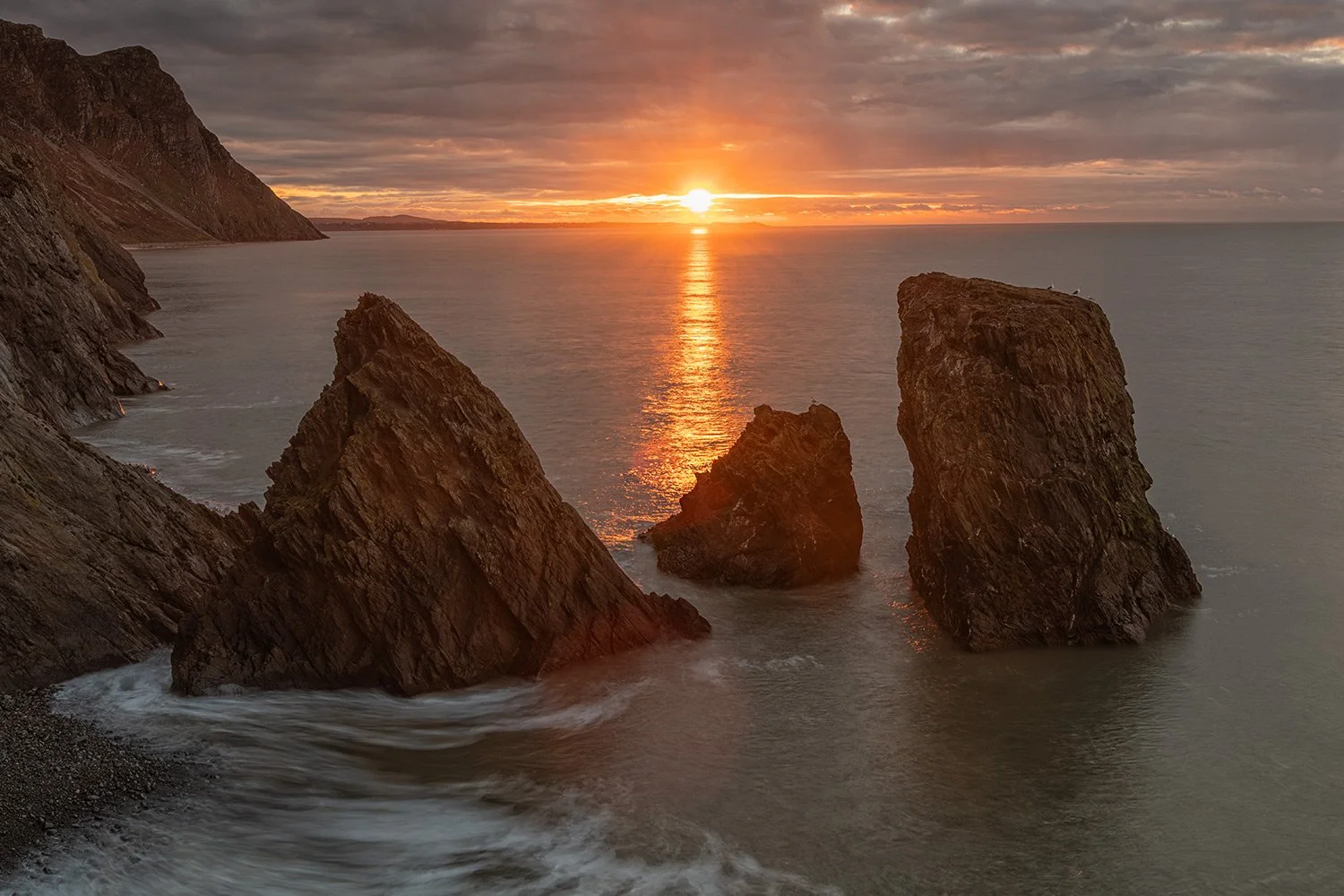
Tucked away on the northern coast of the Llŷn Peninsula in Gwynedd, the Trefor Sea Stacks—locally known as Ynys Fawr and Ynys Fach—are among the most dramatic yet understated coastal formations in North Wales. While places like Llanddwyn Island and South Stack draw crowds of photographers every evening, the rugged granite cliffs below Yr Eifl offer a much quieter, wilder stretch of coastline to explore with a camera.
If you are planning a trip to capture this section of the Wales Coast Path, here is everything you need to know about getting there, the best light, and composing your shots.
How to Get to Trefor Sea Stacks & Parking
The easiest starting point is the small coastal village of Trefor, just off the A499 between Caernarfon and Pwllheli.
Parking: Follow the lane down through the village to the Trefor Beach and harbour car park (postcode: LL54 5LB). There is free parking available near the beach and upper harbour area.
The Walk: From the harbour, follow the Wales Coast Path heading west along the headland. It is a scenic, moderately undulating walk of around 15–20 minutes (roughly 1.2 km) before the cliffs open up to reveal the stacks rising directly out of the Irish Sea.
Safety Note: The path runs close to steep, grassy cliff edges and can be exposed in strong winds, so take extra care if you are walking back after dusk with a tripod.
Best Time of Day & Tide Conditions
Sunset & Seasonal Sun Angles: Because the classic vantage point looks west-southwest along the rugged coastline, sunset is by far the best time to shoot here. Late autumn and winter (especially November and December) are particularly special, as the sun sets at a southerly angle directly behind Ynys Fawr and Ynys Fach, silhouetting the stacks against glowing skies. In spring and summer, the sun sets much further to the north-northwest out over the Irish Sea, casting warm side-light across the granite cliffs instead.
Tide Times: Aim for a mid-to-high tide. At higher water levels, the stacks sit cleanly surrounded by swirling sea water, giving you strong separation between the dark rock and the ocean.
Composition & Gear Tips
Lenses: A wide-angle zoom (such as a 16–35mm or 24–70mm) works brilliantly here. Going wide allows you to anchor your frame with textured cliff-top rocks, coastal thrift, or heather in the foreground while keeping the stacks and the distant horizon balanced. If you want the stacks to have the most impact though, tighter framing is the best option.
Filters: Bring a circular polariser to cut glare off the water and wet rock, along with a 3-stop or 6-stop ND filter if you want to smooth out the incoming swell into misty trails around the base of the stacks.
Stability: Coastal gusts funnel quickly off the slopes of Yr Eifl. Keep your tripod low, avoid extending the centre column, and weigh it down if you are shooting multi-second exposures.
Bring the Welsh Coast Home
If you have walked this stretch of the Llŷn Peninsula—or simply love dramatic North Wales seascapes—my photograph Sunset at Trefor Sea Stacks on the Llŷn Peninsula is available to order as a premium quality lustre print, chunky canvas, or ready-to-hang framed piece.
(Want to discover more hidden photography locations across Eryri, Anglesey, and the Llŷn Peninsula? Take a look at my North Wales Landscape Photography Guidebook or join me on location for a 1-to-1 landscape photography workshop)